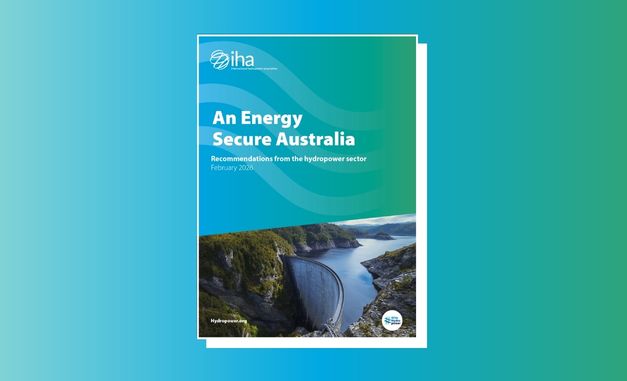
Recommendations from the hydropower sector
Australia’s electricity system is entering a decisive transition phase. As coal-fired generation exits the National Electricity Market (NEM) and renewable penetration accelerates, system reliability will increasingly depend on storage technologies capable of delivering firm, dispatchable power over extended durations. An Energy Secure Australia makes the case that pumped storage hydropower is critical national infrastructure for maintaining energy security, affordability and investor confidence through the transition.
Drawing on the Australian Energy Market Operator’s draft 2026 Integrated System Plan (ISP), the paper highlights the scale of the challenge: storage capacity must expand to 55 GW / 618 GWh by 2050. This requirement cannot be met by short-duration batteries alone. Pumped storage is uniquely suited to provide long-duration (8+ hours) and deep storage (24+ hours), enabling the system to ride through multi-day renewable shortfalls, reduce unserved energy, and stabilise prices during high-impact events.
With operational lifespans of 50–100 years, pumped storage assets deliver intergenerational value and act as “grid insurance” – replacing coal’s reliability while supporting a lowest-cost pathway to net zero. In addition to energy shifting, pumped storage provides essential system services including inertia, frequency control, system strength, rapid ramping and black-start capability, all of which are increasingly scarce in a renewables-dominated grid.
Unlocking Investment at Scale
Despite strong interest and a growing project pipeline, the paper finds that pumped storage deployment is not keeping pace with system needs. High upfront capital requirements, long development timelines, planning and permitting complexity, geotechnical risk, and incomplete market signals continue to constrain final investment decisions.
To address these barriers, the IHA outlines a targeted, investment-ready reform agenda. Key recommendations include embedding long-duration storage targets in national energy planning, implementing and tailoring the Electricity Services Entry Mechanism (ESEM) to recognise pumped storage’s full system value, enabling risk-sharing investment models such as cap-and-floor or concessional finance, and streamlining approvals for strategically important projects. The paper also emphasises the need for early-stage development support through ARENA and CEFC, and stronger coordination between transmission planning and storage deployment to unlock national system benefits.
For policy-makers, the message is clear: explicit planning and market signals for long-duration storage are essential to avoid higher costs, emergency interventions and reliability risks as thermal generation retires. For investors, pumped storage represents a proven, scalable and bankable long-term asset class – delivering stable revenues, system-critical services, and durable alignment with Australia’s decarbonisation objectives