Hydropower in the Deep Freeze: How Plants Keep Power Flowing in Winter
When winter tightens its cold grip, hydropower doesn’t hibernate. For some of the coldest countries on Earth, it becomes even more critical. Drawing on insights from Dr Óli Sveinsson, Executive Vice President of Research and Development at Landsvirkjun and Vice-Chair of the International Hydropower Association (IHA), this article explores how hydropower keeps the lights on during periods of snow, ice and extreme cold.
In cold regions, rivers don’t flow evenly throughout the year. Snow accumulates in the winter, melts in spring and glacial melt peaks in summer. To balance this cycle, large hydropower systems are designed with substantial storage reservoirs, capturing water during warmer, wetter months and releasing it during winter – when natural flows are low and electricity demand is often at its highest.
Countries like Canada, Iceland and Norway rely heavily on hydropower as the backbone of their power systems. Even under extreme winter conditions, hydropower provides reliable, flexible electricity year-round.
Ice is the main operational concern. During cold periods, turbulent and exposed water can become supercooled, leading to the formation of frazil ice - tiny ice crystals that can accumulate on intake trash racks. When this happens, water flow is restricted and energy losses increase. Other forms of ice, including slush ice, broken ice and anchor ice, can also interfere with operations by clogging intakes or reducing available flow. In river channels or open waterways, ice accumulation can sometimes lead to ice dams, which may cause water to back up or, if they fail suddenly, result in downstream flooding. These risks are particularly relevant for run-of-river schemes.
Despite these challenges, hydropower operators in cold regions are well prepared. Reservoirs and waterways usually freeze only at the surface, allowing water to continue flowing freely beneath the ice. Operators often aim to encourage the formation of a stable ice cover by limiting winter water-level fluctuations, reducing the conditions that lead to frazil ice.
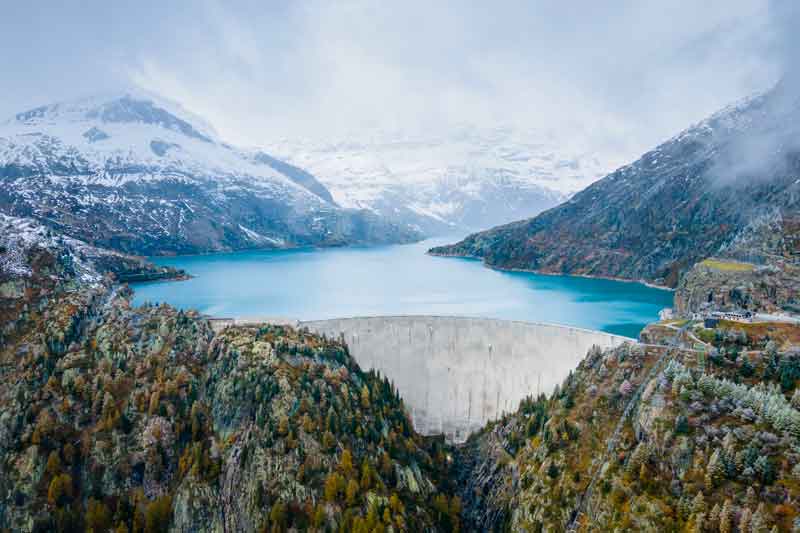
Reliable equipment operation is especially critical in extreme cold. Gates, seals and frames are frequently fitted with heating systems to ensure they remain operational during severe frost. In reservoirs with thick ice cover, careful management of water levels helps prevent ice from damaging dam structures or reservoir banks. In some situations, operators may deliberately raise water levels to break up ice and flush it safely past intake areas rather than allowing it to accumulate.
Climate change is increasing freeze-thaw cycles and winter rainfall events. Hydropower facilities adapt through improved monitoring, longer-term inflow forecasting and optimised production planning. Reservoir management during winter also helps mitigate flooding risks.
Looking ahead, collaboration and innovation will be key to strengthening cold-weather resilience across the sector. Guidance such as the Hydropower Sector Climate Resilience Guide supports the integration of good international industry practice into planning, design and operations, with a strong emphasis on using climate data rather than assuming stable historical conditions. Advances in remote sensing, live cameras and drone surveillance are creating new opportunities to monitor snow and ice across catchments, reservoirs and waterways, while improving flow measurements in ice-covered rivers remains an important area for development.
Built to withstand extreme conditions and designed for exceptionally long lifespans, hydropower facilities can remain operational for generations with proper maintenance and modernisation. Even in the depths of winter, hydropower continues to demonstrate its reliability, flexibility and resilience – keeping clean energy flowing when it is needed most.


.png)