Can shark skin inspire more efficient hydropower turbines?
While hydropower is a mature technology, innovation teams continue to push the boundaries of what is possible within the sector. R&D projects play a key role in this effort by bringing together complementary expertise. This is the approach behind BILASURF, which explored how bio-inspired, laser-textured surfaces could enhance turbine performance.
Hydropower has been converting the energy of flowing water into electricity for well over a century, and modern turbines already achieve remarkably high levels of efficiency. For senior hydraulic engineers such as Élise Mazauric at SuperGrid Institute, further gains often come from targeted innovations backed by rigorous experimental validation. BILASURF set out to investigate one such idea: could microscopic surface structures inspired by shark skin influence water flow within a turbine and unlock additional performance improvements?
Mimicking nature on industrial surfaces
Shark skin owes much of its hydrodynamic efficiency to the microscopic, aligned structures that cover its surface. Inspired by this natural design, the BILASURF team explored how similar microscopic grooves, known as riblets, could be reproduced on engineered surfaces. Applied to hydropower turbines, these structures could help keep the flow attached to blade profiles, reducing wall friction and mitigating flow separation. The goal is to minimise associated energy losses and enhance turbine efficiency.
Short for Bio-inspired Laser Functionalisation of Complex 3D Industrial Surfaces, BILASURF sets out to develop a high-rate laser process capable of applying tailored riblets to large, complex industrial components. Unlike coating, the structures are engraved directly into the material.
The project brought together ten European partners spanning the entire technology value chain. Ceit coordinated the initiative and optimised laser processing parameters, while AIMEN contributed expertise in laser micro-cladding, in-line process monitoring and sustainability assessment. Fraunhofer IWU, Fusion Bionic and Workshop of Photonics focused on laser micro structuring, surface functionalisation and system development.
In parallel, Bionic Surface Technologies designed the riblet structures and evaluated their expected performance using Computational Fluid Dynamics (CFD). GLOBAL Hydro and ZIEHL-ABEGG developed hydropower and ventilation demonstrators respectively. SuperGrid Institute assessed the hydropower demonstrator through hydraulic model testing, while Secpho supported collaboration activities and project dissemination.
Together, the consortium combined expertise in advanced manufacturing, fluid dynamics, surface engineering and industrial validation to investigate the potential of bio-inspired surface technologies in real-world applications.
For turbines, even modest performance improvement can be valuable when competing in tenders. SuperGrid Institute was responsible for determining whether these bio-inspired surfaces measurably improved the hydraulic behaviour of turbine components.
Testing riblets on a Francis turbine model
GLOBAL Hydro supplied a reduced-scale Francis turbine model. Widely used across medium- and high-head sites, Francis turbines convert hydraulic energy through a runner supplied by adjustable guide vanes, which regulate flow entering the machine.
Performance improvement was expected from a configuration combining a textured runner and textured guide vanes. Functionalising these complex geometries was itself a technical challenge: three laser-texturing approaches were investigated, and one was selected for the hydropower demonstrator. The process was successfully applied to the model’s twenty guide vanes, which were tested against smooth guide vanes. However, due to the time required to functionalise the complex blade geometry, the runner could not be textured within the project schedule. The full-turbine campaign therefore assessed riblets on the guide vanes only, rather than the combined guide vane and runner configuration from which the strongest performance improvement was expected. This restricted experimental scope was central to interpreting the results.
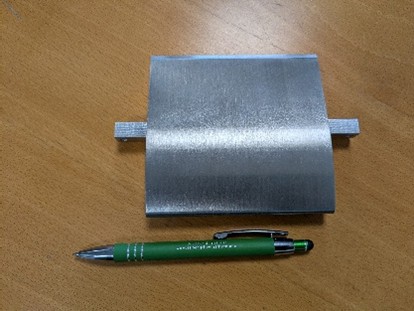
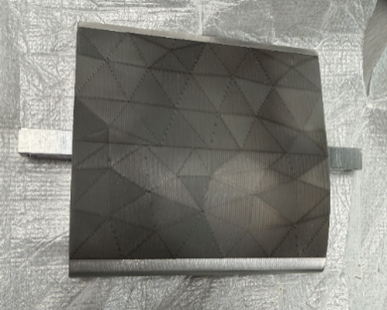
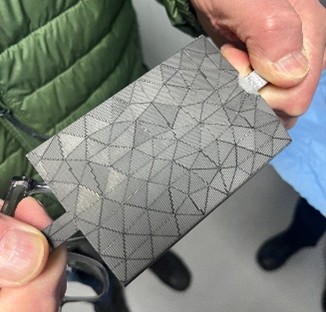
Threelaser-texturing approaches investigated for the hydropower demonstrator, including the riblet geometry selected for the guide vanes ©SuperGrid Institute
Tests were conducted on one of SuperGrid Institute’s hydraulic test rigs, an IEC 60193-compliant platform for hydraulic turbine model acceptance tests. This test rig enables researchers to control hydraulic head and flow rate, establish efficiency hill charts and reproduce pressure conditions representative of hydropower sites.
The campaign also assessed cavitation areas. Cavitation occurs when local flow pressure falls below the vapour pressure of water, creating cavities that subsequently collapse. Flow incidence and increased velocity can produce the pressure drop, potentially reducing performance and causing vibration and material damage. IEC 60193 hydraulic test rig’s-controlled pressure conditions allowed the turbine’s hydraulic performance and cavitation behaviour to be evaluated together.
From model testing to dam scale
A central challenge when roughness is anisotropic is converting results from laboratory models to full-scale equipment. Depending on the project, a turbine model may be three to thirty times smaller than the site machine. Hydraulic effects observed on a model cannot therefore be extrapolated without considering component size and operating conditions. The IEC international hydraulic standard assesses model-to-prototype transposition formulae for isotropic roughness, but do not in case of textured surfaces such as the ones with riblets.
SuperGrid Institute compared experimental measurements and CFD predictions for smooth and textured hydrofoil profiles at scale factors 1 and 1.4. The same physical riblet dimensions were applied to both sizes, allowing the team to investigate whether a texture developed for one component scale could be transposed directly to another. The comparison confirmed that scale influences the hydraulic response and must therefore be considered when defining riblet geometry.
To isolate the riblets’ effects, the test focus moved from the complete turbine to hydraulic blade profiling in SuperGrid Institute’s low-flow water tunnel. Geometrically similar smooth and textured profiles were tested under controlled flow velocities and incidence angles. The facility enabled direct lift and drag measurements. By removing the interactions between the turbine’s multiple hydraulic components, this approach provided a more sensitive assessment of the riblets’ hydraulic influence and a robust basis for comparison with CFD predictions.
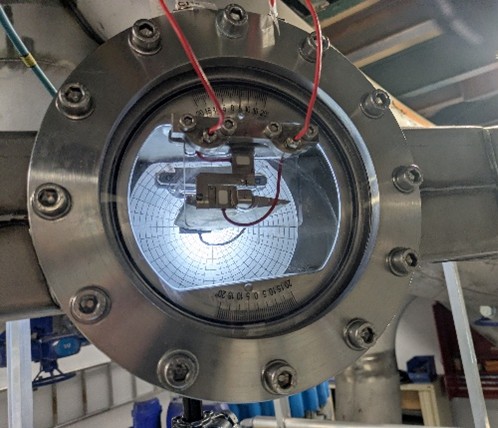
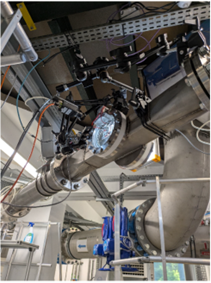
A ribleted hydrofoil under test in SuperGrid Institute’s low-flow water tunnel, where lift, drag and flow separation were measured under controlled conditions ©SuperGrid Institute
Meaningful results and open questions
The low-flow water tunnel tests provided the clearest experimental evidence of the riblets’ hydraulic influence. Hydraulic blade profiling showed measurable improvements in lift and drag for the textured profiles, while flow visualisation helped characterise their effect on flow separation. Percentage gains were higher at scale factor 1 than at scale factor 1.4, confirming that riblet geometry must be adapted to component scale and operating conditions. CFD simulations comparing configurations with and without riblets on both the guide vanes and runner also produced encouraging indications. Together, these results provide a sound basis for refining the texture design and identifying the turbine components on which riblets could deliver the greatest hydraulic benefit.
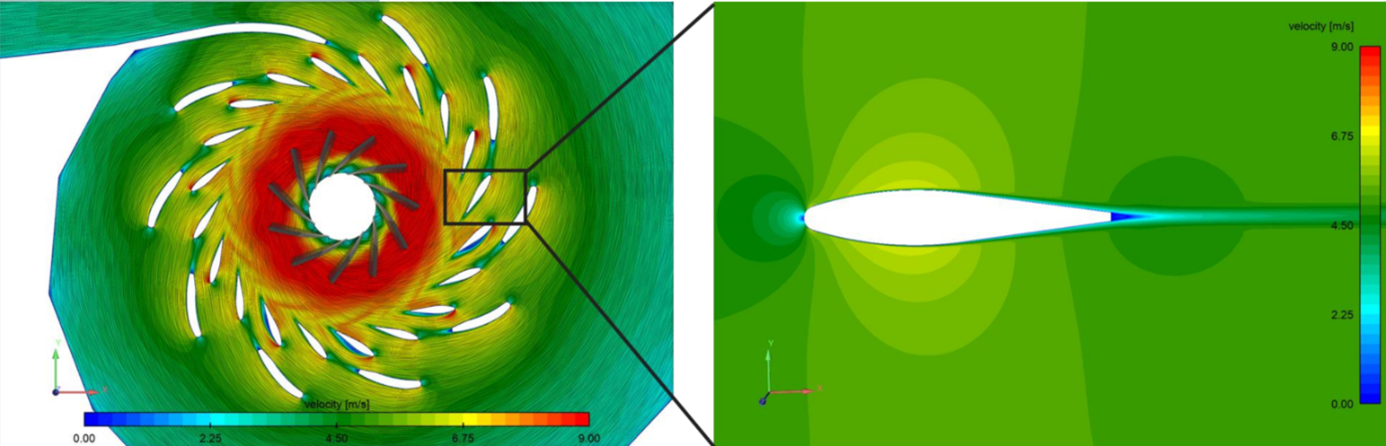
Computational Fluid Dynamics (CFD) simulation of the water velocity field around the guide vane ©SuperGrid Institute
No significant difference in cavitation behaviour was observed between the smooth and textured turbine configurations. The full-model campaign also provided insufficient evidence that riblets applied only to the guide vanes improved overall turbine efficiency. These results must be interpreted considering the experimental scope, as the combined textured guide vane and runner configuration was not tested.
BILASURF demonstrated the feasibility of laser-functionalising complex turbine components while identifying the remaining industrial questions: manufacturing time, abrasion resistance, durability in sediment-laden water and long-term economic value. The project also shows how hydropower can progress by combining biomimetics, laser manufacturing, fluid mechanics, numerical simulation and hydraulic testing.
For Élise Mazauric, the work reflects the purpose of a demonstrator: not necessarily to provide a binary answer, but to identify the parameters that must be mastered before industrial deployment. On Global Hydropower Day, BILASURF shows that innovation in Hydropower can begin at a microscopic scale and open a credible research path for the next generation of hydropower equipment.

.png)